Dermatoscope and Magnifiers
 Diagnostic Kits
 Vital Signs Monitors
 Stethoscopes and Accessories
 Otoscopes, Ophthalmoscopes, and Retinoscopes
 Reflex Hammers and Neurological Tools
 Scales and Measuring Devices
 Spirometers and Pulmonary Function Tests
 Electrosurgical Units and Accessories
 Cutting Instruments
 Grasping and Holding Instruments
 Hemostatic Instruments
 Specialized Surgical Sets
 Single-Use Procedure Trays and Packs
 Surgical Drapes, Gowns, and Covers
 Tissue Unifying Instruments
 Radiation Protection
 X-Ray Machines and Accessories
 Ultrasound Systems and Probes
 MRI and CT Scanners
 Radiology Consumables
 Bone Densitometers
 Fluoroscopy Equipment
 Imaging Tables and Positioning Aids
 Microscopes and Accessories
 Centrifuges and Separators
 Analyzers
 Incubators and Ovens
 Pipettes, Dispensers, and Lab Glassware
 Refrigerators, Freezers, and Storage Units
 Lab Consumables
 Sterilizers and Autoclaves for Lab Use
 Multi-Parameter Monitors
 Ventilators and Respiratory Support Devices
 Defibrillators and AEDs
 Infusion Pumps and IV Systems
 Patient Warmers and Cooling Devices
 Central Monitoring Stations
 Accessories
 Anesthesia Machines and Workstations
 Oxygen Concentrators and Delivery Systems
 Nebulizers and Inhalers
 CPAP/BiPAP Machines
 Airway Management
 Anesthesia Masks, Circuits, and Bags
 Humidifiers and Heaters
 Respiratory Therapy Accessories
 First Aid Kits and Cabinets
 Emergency Resuscitation Equipment
 Trauma Supplies
 Emergency Carts and Crash Carts
 Burn Care Products
 Bleeding Control
 Automated External Defibrillators (AEDs)
 Transport and Evacuation
 Wheelchairs and Accessories
 Walkers, Crutches, and Canes
 Prosthetics and Orthotics
 Physical Therapy Equipment
 Transfer Devices
 Bathroom Safety
 Orthopedic Traction and Tables
 Hot/Cold Therapy Packs and Units
 Beds and Mattresses
 Chairs and Stools
 Tables
 Cabinets and Storage
 Privacy Screens & Curtains
 Stands and Racks
 Linens and Textiles
 Lighting
 Autoclaves and Sterilizers
 Ultrasonic Cleaners
 Disinfectant Solutions and Wipes
 Sterilization Pouches, Wraps, and Indicators
 Instrument Trays and Containers
 UV and Ozone Disinfection Devices
 Washer Disinfectors
 Wound Care
 Gloves
 Masks and Respirators
 Catheters and Tubing
 Swabs, Applicators, and Sponges
 Incontinence Products
 Personal Protective Equipment (PPE)
 Dental Chairs and Units
 Handpieces and Burs
 Instruments
 Consumables
 Sterilization for Dental Use
 Orthodontic Supplies
 Endodontic Tools
 Slit Lamps and Tonometers
 Lensometers and Phoropters
 Ophthalmic Surgical Instruments
 Eyewear Frames and Lenses
 Contact Lens Supplies
 Vision Testing Charts and Devices
 Eye Care Consumables
 Laser Systems for Eye Care
 ENT Exam Chairs and Tables
 Endoscopes
 Audiometers and Hearing Tests
 ENT Instruments
 Nasal and Throat Packs
 Hearing Aids and Accessories
 Otology Supplies
 Fetal Dopplers and Monitors
 Delivery Beds and Tables
 Gynecological Instruments
 Neonatal Incubators and Warmers
 Breast Pumps and Accessories
 Contraceptive Devices
 Maternity Supports and Pads
 Neonatal Consumables
 Cystoscopes and Urethroscopes
 Dialysis Machines and Supplies
 Urological Catheters and Bags
 Lithotripters
 Prostate Treatment Devices
 Urinary Incontinence Products
 Kidney Stone Management Tools
 Consumables & Disposables
 EEG and EMG Machines
 Neurosurgical Instruments
 Nerve Stimulators
 Headrests and Positioning Aids
 Lumbar Puncture Kits
 Seizure Monitoring Devices
 Consumables
 Rehabilitation for Neurological Conditions
 ECG Machines and Accessories
 Holter Monitors
 Stress Test Systems
 Pacemakers and Defibrillator Accessories
 Vascular Access Devices
 Cardiac Catheters and Guidewires
 Blood Flow Meters
 Consumables
 Orthopedic Instruments
 Casts, Splints, and Padding
 Joint Replacement Supplies
 Prosthetic Limbs and Components
 Bone Grafts and Substitutes
 Traction Devices
 Orthopedic Braces and Supports
 Rehabilitation Aids for Orthopedics
 Home Oxygen Therapy
 Hospital Beds for Home Use
 Mobility Aids
 Bathroom and Daily Living Aids
 Wound Care for Home
 Monitoring Devices
 Enteral Feeding Pumps and Tubes
 Hand Sanitizers and Dispensers
 Face Shields and Goggles
 Isolation Gowns and Suits
 Biohazard Waste Containers
 Air Purifiers and HEPA Filters
 Surface Disinfectants
 Sharps Containers
 Protective Barriers
 Cardiovascular & Endurance Training
 Strength Training & Weightlifting
 Functional Training & Core Conditioning
 Physical Therapy & Rehabilitation
 Sports & Outdoor Recreation
 Gym Flooring & Facility Equipment
 Fitness Monitoring & Accessories
 Kids & Novelties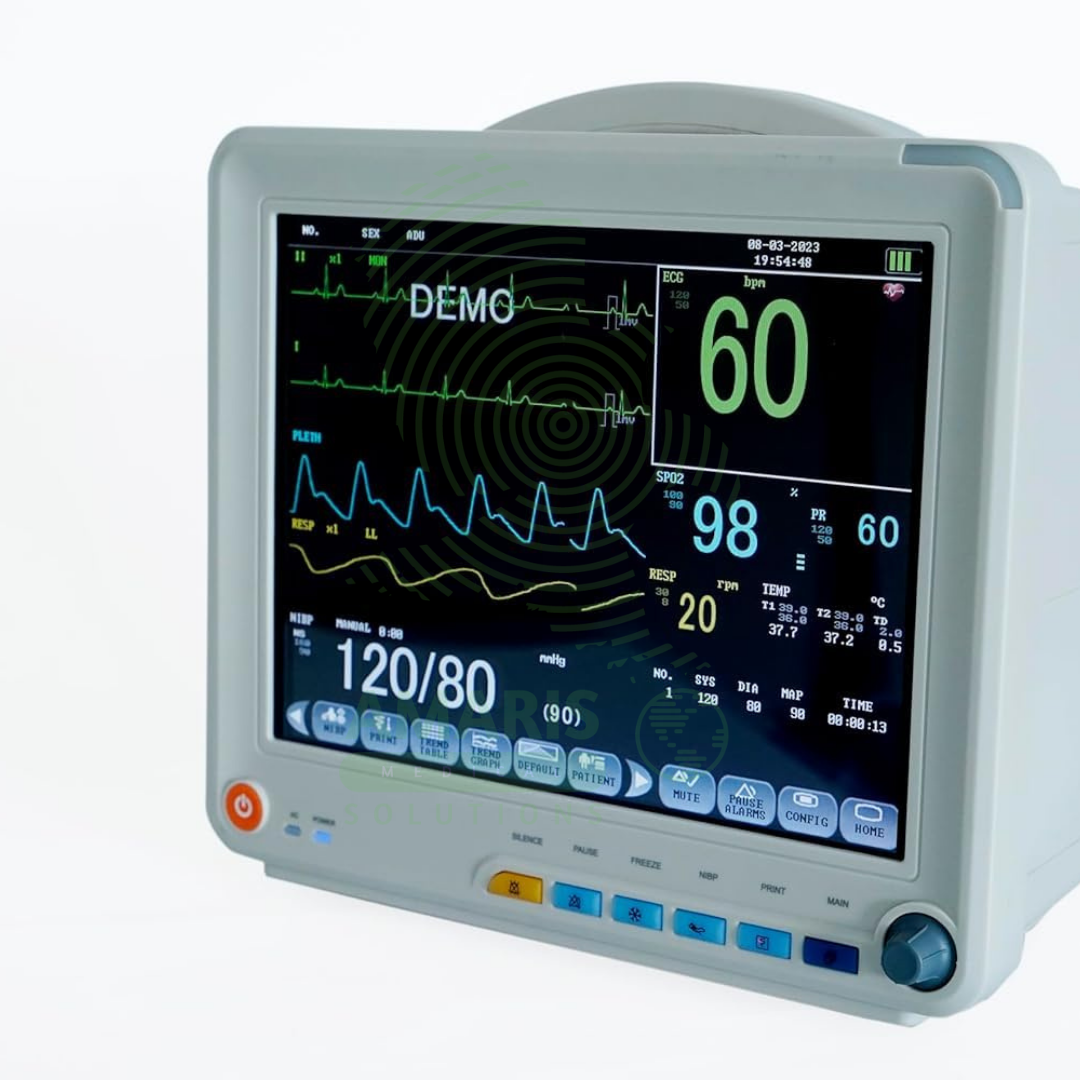
Patient Monitor
WhatsApp Order
The Patient Monitor (6 Parameters BCCMS8000) is a versatile multi-parameter monitor designed for continuous surveillance of core vital signs in various clinical settings. It tracks six essential parameters—ECG, SpO2, Non-Invasive Blood Pressure (NIBP), Respiration, Temperature, and Pulse Rate—providing clinicians with real-time waveforms and numerical data on a clear color display. With its robust alarm system, battery backup for transport, and reliable performance, it is a fundamental tool for ensuring patient safety on general hospital wards, during procedures, and in emergency departments. Its design balances comprehensive monitoring capability with user-friendly operation.
Description
Patient Monitor
PRIMARY CLINICAL & DIAGNOSTIC USES
1. Continuous Vital Signs Monitoring in General Ward Settings:
-
Primary Use: The primary use is for the non-invasive, continuous monitoring of core physiological parameters for stable but at-risk inpatients on medical-surgical floors, step-down units, and post-operative recovery areas.
-
How it helps: Keeps a constant watchful eye on patients who are stable enough to be out of the ICU but still need close observation, alerting nurses immediately if a patient’s heart rate, blood pressure, or oxygen levels begin to drift into dangerous territory.
2. Anesthesia & Procedural Sedation Monitoring:
-
Primary Use: Serves as a standard of care during surgical procedures under anesthesia and for moderate sedation during endoscopic or other bedside procedures to ensure patient stability.
-
How it helps: Provides the anesthesia team with real-time feedback on how a patient’s body is responding to surgery and anesthesia, allowing them to make split-second adjustments to keep the patient safe and stable throughout the procedure.
3. Emergency Department Triage & Observation:
-
Primary Use: Provides immediate and continuous assessment of patients in the ED, from initial triage through observation stays, allowing for rapid detection of clinical deterioration.
-
How it helps: Helps emergency physicians prioritize care by continuously tracking vital signs, ensuring that a patient whose condition is worsening is immediately identified and moved up for treatment.
4. Inter-Hospital & Intra-Hospital Patient Transport:
-
Primary Use: Its portable design makes it essential for safely monitoring critically ill or unstable patients during transfers between departments (e.g., to radiology) or between facilities.
-
How it helps: Extends the safety net of the ICU or ED during transport, ensuring that a patient’s condition is monitored every second they are away from their unit, with alarms that alert the transport team to any problems.
5. High-Dependency Patient Monitoring:
-
Primary Use: Used for patients who require closer observation than standard ward care but do not yet need intensive care, such as those on specific medication drips, with worsening chronic conditions, or post-complex procedures.
-
How it helps: Bridges the gap between general ward care and intensive care, providing a higher level of monitoring for patients who need it without the cost and resource intensity of an ICU bed.
SECONDARY & SUPPORTIVE USES
1. Cardiac Stress Testing Support: Often used in conjunction with treadmill or pharmacological stress tests to monitor ECG and hemodynamic responses in real-time, helping doctors assess how the heart responds to exertion.
2. Respiratory Therapy & Oxygen Titration: Assists in titrating oxygen therapy by providing continuous SpO2 readings and respiratory rate monitoring for patients with COPD, pneumonia, or other respiratory conditions, ensuring they receive exactly the right amount of oxygen.
3. Long-term Care & Sub-Acute Facility Monitoring: Provides a level of monitoring in skilled nursing facilities (SNFs) or rehabilitation centers for patients with significant cardiac or respiratory comorbidities, extending hospital-level monitoring to long-term care settings.
4. Clinical Training & Education: Used as a teaching tool for nursing and medical students to understand normal and abnormal vital sign trends and alarm management, training the next generation of healthcare providers.
KEY PRODUCT FEATURES
1. BASIC IDENTIFICATION ATTRIBUTES
-
Product Name: Patient Monitor
-
Type: Multi-Parameter Patient Monitor (MPM)
-
Monitoring Parameters: ECG, SpO2 (Pulse Oximetry), NIBP (Non-Invasive Blood Pressure), Respiration, Temperature, and likely Pulse Rate (derived from ECG/SpO2).
-
Display: Integrated color TFT/LCD screen (typically 12.1-inch or similar) for real-time waveform and numerical display.
-
Form Factor: Designed as a portable unit with a carrying handle or as a compact bedside monitor, often with a modular docking system.
2. TECHNICAL & PERFORMANCE PROPERTIES
-
ECG Monitoring: Typically 3 or 5-lead configuration. Features include heart rate calculation, arrhythmia detection (PVCs, tachycardia, bradycardia), ST-segment analysis, and multiple selectable filter modes (monitor, diagnostic, filter).
-
SpO2 Monitoring: Measures arterial oxygen saturation and pulse rate via finger probe. Includes plethysmograph waveform and adjustable alarm limits for low saturation.
-
NIBP Monitoring: Automated oscillometric measurement of systolic, diastolic, and mean arterial pressure. Features include manual/auto cycling, STAT mode, and adjustable cuff sizes.
-
Respiration Monitoring: Typically measured via impedance pneumography through the ECG electrodes (thoracic impedance changes).
-
Temperature Monitoring: Via a single-use or reusable skin or rectal probe.
-
Alarm System: Comprehensive visual and audible alarms for each parameter with priority levels (e.g., high, medium, low). Includes alarm pause and sound level adjustment.
3. PHYSICAL & OPERATIONAL PROPERTIES
-
Power Supply: Dual power source - operates on AC mains power and a built-in rechargeable battery for uninterrupted monitoring during transport or power loss.
-
Battery Life: Typically provides 3 to 5 hours of continuous operation on a full charge.
-
Connectivity: Standard ports include USB for data export, Ethernet or optional WiFi for network connectivity to a Central Station Monitoring System.
-
User Interface: Combination of front-panel buttons, knobs, and/or a touchscreen for intuitive navigation and parameter setup.
4. SAFETY & COMPLIANCE ATTRIBUTES
-
Regulatory Approvals: Must carry CE Marking (for EU market) and/or FDA 510(k) Clearance (for US market). Compliance with medical device directives (MDD/MDR) is essential.
-
Safety Standards: Complies with IEC 60601-1 (General Safety), IEC 60601-1-2 (Electromagnetic Compatibility), and IEC 60601-2-27 (Particular requirements for ECG monitoring equipment).
-
Protection Class: Type CF applied part for defibrillation protection on ECG leads.
5. STORAGE & HANDLING ATTRIBUTES
-
Environmental Conditions: Designed for hospital use. Operating temperature typically 10°C to 40°C, humidity 30% to 75% non-condensing. Storage temperature range is wider.
-
Cleaning & Disinfection: The casing should be cleaned regularly with a soft cloth dampened with hospital-grade disinfectant (e.g., diluted bleach or alcohol-based solutions compatible with plastics). Avoid liquid ingress into ports or vents.
-
Calibration: Requires periodic performance verification and calibration as per the manufacturer's service schedule and local regulatory requirements.
6. LABORATORY & CLINICAL APPLICATIONS
-
Primary Application: Continuous physiological surveillance to detect and alert caregivers to early signs of patient deterioration across various hospital departments.
-
Supportive Application: Provides documented vital sign trends for patient records, supports clinical decision-making, and is integral to patient safety protocols.
SAFETY HANDLING PRECAUTIONS
1. SAFETY PRECAUTIONS
-
Personal Protective Equipment (PPE): Standard precautions apply. Gloves should be worn when applying ECG electrodes or if there is risk of contact with bodily fluids.
-
Patient Safety: Ensure correct electrode placement for accurate ECG and respiration. Use appropriate-sized blood pressure and SpO2 cuffs/probes to avoid injury or inaccurate readings. Inspect skin under probes periodically.
-
Device & Electrical Safety: Use only manufacturer-approved accessories (cuffs, probes, cables). Do not use if the housing is cracked or damaged. Ensure proper grounding and do not use in the presence of flammable anesthetics.
2. FIRST AID MEASURES
-
General: Patient care takes priority. In an emergency, disconnect non-essential monitoring if it impedes care.
-
Skin Irritation: Remove the offending electrode or probe. Clean skin with soap and water. Seek medical advice for persistent reactions.
-
Device Malfunction: If the monitor malfunctions (e.g., overheats, smokes), disconnect it from the patient and power source immediately. Replace with another monitor.
3. FIRE FIGHTING MEASURES
-
Flammability: Contains plastics, electronic components, and a lithium battery, all of which are combustible.
-
Extinguishing Media: For electrical fires, use CO₂ or dry powder extinguishers. Do not use water jets directly on the device.
-
Hazardous Combustion Products: Burning electronics can release toxic fumes (e.g., carbon monoxide, hydrogen fluoride from batteries).
-
Firefighter Instructions: Wear full protective gear and SCBA. Remove the device from the vicinity if safe to do so.
Related products
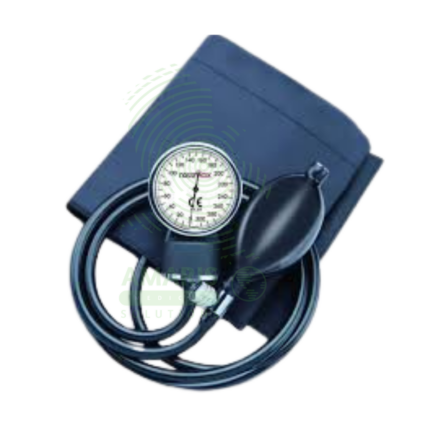
Aneroid Blood Pressure Monitor
The Aneroid Blood Pressure Monitor is a manual, mechanical sphygmomanometer used for the accurate, non-invasive measurement of arterial blood pressure. Operating on the auscultatory method, it consists of an inflatable cuff, a pump bulb with a release valve, and a calibrated dial gauge. Renowned for its reliability, durability, and independence from electrical power, it serves as a clinical gold standard and essential tool in physician offices, hospitals, and for guided home monitoring. Its accuracy is dependent on proper technique, correct cuff size, and regular calibration, making it a fundamental device for diagnosing and managing hypertension and assessing cardiovascular health.
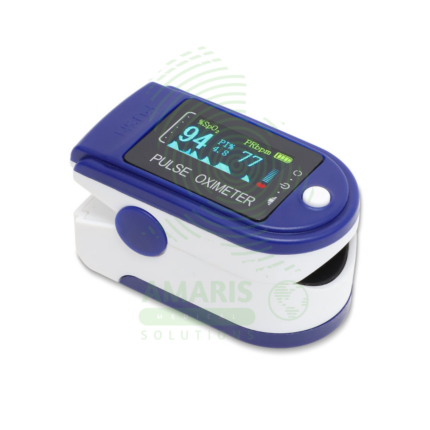
Fingertip Pulse Oximeter
A Fingertip Pulse Oximeter is a compact, non-invasive medical device that clips onto a finger to measure peripheral arterial oxygen saturation (SpO2) and pulse rate in seconds. Utilizing light-based technology, it provides critical, real-time data on respiratory and circulatory status. Its portability and ease of use make it indispensable in hospitals (from ORs to general wards), for patients managing chronic lung conditions at home, and for situational monitoring in sports or high-altitude environments. While an extremely valuable screening tool, readings must be interpreted in context, considering factors like patient movement, perfusion, and clinical symptoms.
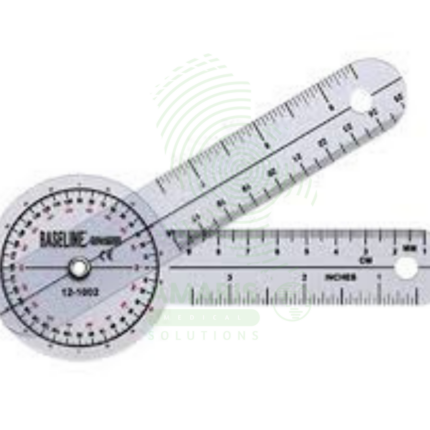
Goniometer
A goniometer is a calibrated, handheld measuring instrument designed to precisely quantify joint range of motion in degrees. Essential for physical and occupational therapy, orthopedic assessment, and rehabilitation medicine, it consists of a protractor-like body with two arms—one stationary, one movable—that align with the patient's limb segments. Available in various sizes for different joints (from fingers to hips) and in materials including transparent plastic, stainless steel, and digital formats, it transforms subjective observations of mobility into objective, reproducible data. This fundamental clinical tool guides diagnosis, documents treatment progress, supports disability determinations, and provides the evidence base for therapeutic interventions.
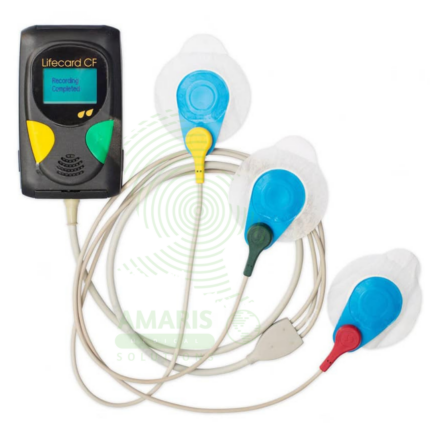
Holter ECG Monitor
A Holter ECG Monitor is a portable, wearable medical device used for continuous, long-term recording of a patient's heart's electrical activity over 24 to 48 hours or more. It is the cornerstone diagnostic tool for detecting intermittent cardiac arrhythmias, evaluating unexplained symptoms like syncope or palpitations, and monitoring the efficacy of antiarrhythmic treatments or implanted cardiac device function. Consisting of a small digital recorder connected to chest electrodes (or an all-in-one adhesive patch), it allows patients to maintain their normal daily routine while capturing a comprehensive electrocardiographic record.
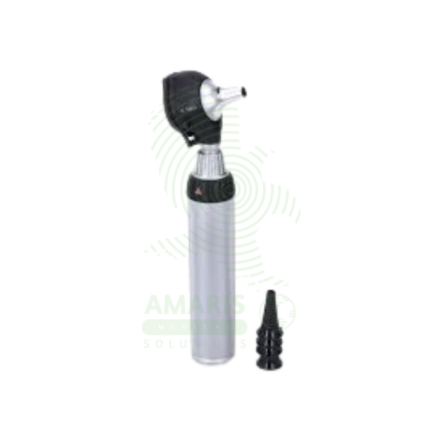
LED Otoscope
An LED Otoscope is a handheld medical device used for illuminating and magnifying the external ear canal and tympanic membrane. Featuring a bright, cool, and long-lasting LED light source, it provides superior visualization for diagnosing common conditions like ear infections, wax impaction, and perforations. Its design, incorporating a reusable handle/head and disposable specula, ensures hygiene and patient safety. As an essential tool in family medicine, pediatrics, and ENT, it enables clinicians to perform accurate otoscopic examinations and, when equipped with an insufflator, crucial pneumatic otoscopy to assess middle ear function.
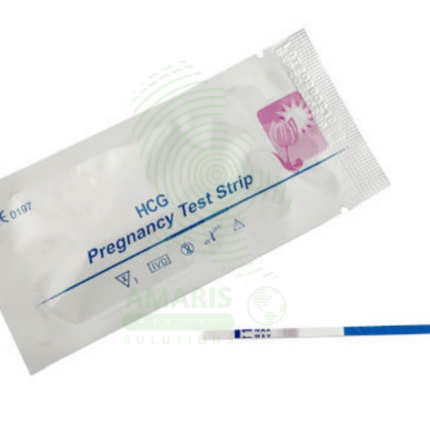
Pregnancy Test Strips
Pregnancy Test Strips are simple, dip-style lateral flow devices designed for the rapid, qualitative detection of human chorionic gonadotropin (hCG) in urine to indicate pregnancy. As the most fundamental format of home pregnancy tests, they offer high sensitivity (often from 10 mIU/mL), affordability, and a quick result within 3-5 minutes. Their ease of use makes them a widely accessible first step in pregnancy detection for personal use and clinical screening. A visible test line, even if faint, is a positive result, though confirmation with a healthcare provider is always recommended.
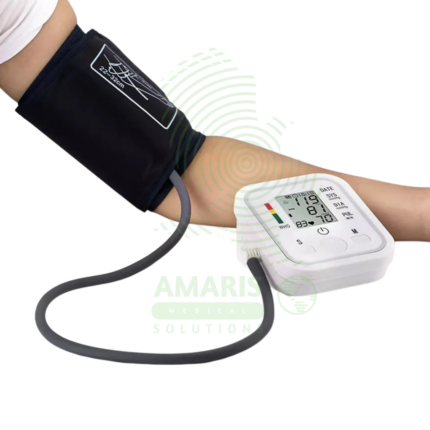
Upper Arm Blood Pressure Monitor
The Upper Arm Blood Pressure Monitor is a clinically validated, automatic digital device designed for accurate and comfortable blood pressure and pulse measurement at home or in professional settings. Known for its user-friendly features like Intellisense inflation technology, a large clear display, and comprehensive functions including irregular heartbeat detection, multi-user memory, and a WHO-based hypertension indicator, it provides reliable data for effective hypertension management. Its robust construction, adherence to international safety standards (CE, FDA), and focus on patient comfort make it a trusted choice for individuals and healthcare providers seeking a dependable tool for cardiovascular health monitoring.